Skip to content



What are tics - motor and vocal?
A tic is a sudden, rapid and repetitive movement or sound, It's a kind of behaviour that happens outside of the person's conscious control. It has no functional purpose, appears without warning and tends to repeat itself in the same way over and over again. It's not a choice - is the nervous system acting on its own.
Motor tics
They involve the movement of the body's muscles. They can be simple - blink, grimace, shake your head, shrug your shoulders - or complex, These are elaborate sequences of movements or gestures with a defined pattern.
Vocal tics
They involve sounds produced by the voice or the respiratory system. The simple These include sniffling, coughing for no reason or sniffling. The complex may involve repeating words spoken by others (echolalia), the own words (palilalia) or, in a small number of cases, involuntary vocalisation of obscene words - the so-called coprolalia.
An important featuretic: many people feel an “urgency” before performing the tic - an internal tension that is only relieved by movement or sound. It's like an itch that disappears when you scratch it.
Tics vs. Tourette's Syndrome: what's the difference?
A Tourette's Syndrome It's not simply “having tics” - it's a specific diagnosis with well-defined clinical criteria. To establish this diagnosis, it is necessary to check all the following:
- Presence of multiple motor tics (at least two different ones)
- Presence of at least one vocal tic
- Duration of more than one year
- Home before the age of 18
- Absence of another medical cause explaining the tics
In other wordsTourette's Syndrome: a child who blinks repeatedly for a few months does not necessarily have Tourette's Syndrome - it may be a transient tic, very common in childhood, which disappears on its own. There are also chronic ticsTourette's Syndrome: persists for more than a year, but is only motor or only vocal - never both at the same time. Tourette's Syndrome is the most complex form of this spectrum.
The most persistent myth about Tourette Syndrome is coprolalia - involuntary swearing. In reality, it is present in less than 30% of cases.
Having tics doesn't mean having Tourette's either.
What goes on in the brains of people with tics?
The neurobiology of tics points to dysfunctions in the circuits that connect the cerebral cortex to the brain. basal ganglia - deep structures of the brain responsible for filter and control movements. When these circuits malfunction, certain movements or sounds that should be “stopped” by the brain end up manifesting themselves involuntarily.
There is also evidence of deregulation of dopamine - the neurotransmitter associated with movement and reward. This explains why tics tend to worsen in situations of stress or anxietyThese are states that alter the levels of this neurotransmitter, making the circuits even more unstable.
Who is affected and what to expect?
Tics are more common than most people realise. It is estimated that between 10 to 20% of school-age children show some kind of tic at some point. Tourette's Syndrome affects between 3 to 9 per 1000 children, where 3 to 4 times more frequent in boys.
The outlook is, in many cases, positive: studies point to remission in up to 85% of cases in adulthood, with the most intense phase typically occurring between the ages of 10 and 12. When tics persist, they tend to be milder and more manageable.
Tourette's Syndrome often co-occurs with Attention Deficit Hyperactivity Disorder (ADHD) and Obsessive-Compulsive Disorder (OCD) - a reflection of shared dysfunctions in the same brain circuits. That's why an integrated assessment is always essential.
If your child has tics, avoid drawing attention to them repeatedly - social pressure increases stress and can intensify episodes. Inform the school and those close to you about what tics are: understanding the environment is often the factor that makes the most difference in everyday life.
What approaches are there?
Not all tics require treatment. When they are mild and don't interfere with daily life, the Psychoeducation - explaining to yourself, your family and your school what tics are and how they work - is often enough to reduce stigma and anxiety.
When intervention is necessary, the following stand out Behavioural therapy (in particular Comprehensive Behavioural Intervention for Tics, which trains the person to recognise and replace the pre-tic impulse with an alternative behaviour) and, in the most severe cases, the pharmacotherapy with dopaminergic modulators.
In the field of neurotherapies, the Neurofeedback has shown promising results in training the brain to self-regulate its electrical activity - with studies documenting significant reductions in the frequency of tics.
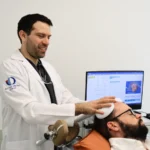
A Transcranial Magnetic Stimulation (TMS) acts directly on the cortical circuits involved, with documented benefits in the intensity and frequency of tics, without the side effects of prolonged medication. At NeuroPsyque, these approaches are part of a personalised assessment and treatment model, centred on each person's neurological profile.
🧠 Key Points to Retain
- Tics are involuntary, sudden and repetitive movements or sounds - they are neither choice nor purposeful behaviour.
- They are divided into motors e vocals, They can be simple or complex.
- A Tourette's Syndrome requires multiple motor tics e at least one vocal tic, lasting more than a year and beginning before the age of 18.
- Coprolalia is rare and does not define the syndrome - it affects less than 30% of cases.
- Tics result from dysfunctions in the basal ganglia-cortex circuits and dopaminergic dysregulation.
- Around 85% of Tourette's cases improve in adulthood.
- ADHD and OCD are frequent comorbidities that should be assessed together.
- The treatment is proportional to the impact: psychoeducation, behavioural therapy, Neurofeedback and Transcranial Magnetic Stimulation.
FAQs - Frequently Asked Questions
Do tics get worse with stress?
Yes. Stress raises dopamine and cortisol levels and tends to increase the frequency and intensity of tics. Stress management strategies - regular physical exercise, quality sleep and relaxation techniques - have an impact on the actual expression of tics.
My son has tics. When should I seek specialised help?
Most childhood tics are transient and resolve without intervention. The time to consult a specialist comes when tics persist for more than a year, interfere with learning or social life, or when there is associated suffering.
Can neurofeedback help with tics?
Yes. Recent studies have shown significant reductions in the frequency of tics with Neurofeedback, by training the brain to self-regulate its electrical activity. It's a non-invasive approach, with no significant side effects, and particularly useful when you want to avoid or complement medication.
Is Tourette Syndrome hereditary?
There is a relevant genetic component - the syndrome tends to run in families. However, the expression of symptoms varies greatly between family members: one person may have the full syndrome while a relative has only mild, transient tics.