Skip to content


What Are the Milestones of Child Development?
The milestones in development These are the benchmarks observed and studied in children over the years.
Child development follows a a more or less predictable sequence.
For example, almost all children support their head before sitting down, they sit before they walk, make sounds before they speak words, and speak words before they form sentences.
The milestones in development are the most visible landmarks in this sequence — they are the skills acquisition which show that the child is making natural progress.
These milestones help guide parents, and for healthcare professionals they serve as a tracking system: when several skills are acquired late, or one that was previously present disappears, it is a sign that we need to take a closer look.
But bear in mind the key point: the milestones describe what the majority does — not a rule to be followed, with strict deadlines. A delay in acquiring a particular skill does not in itself mean that anything is wrong.
The 5 Areas of Development
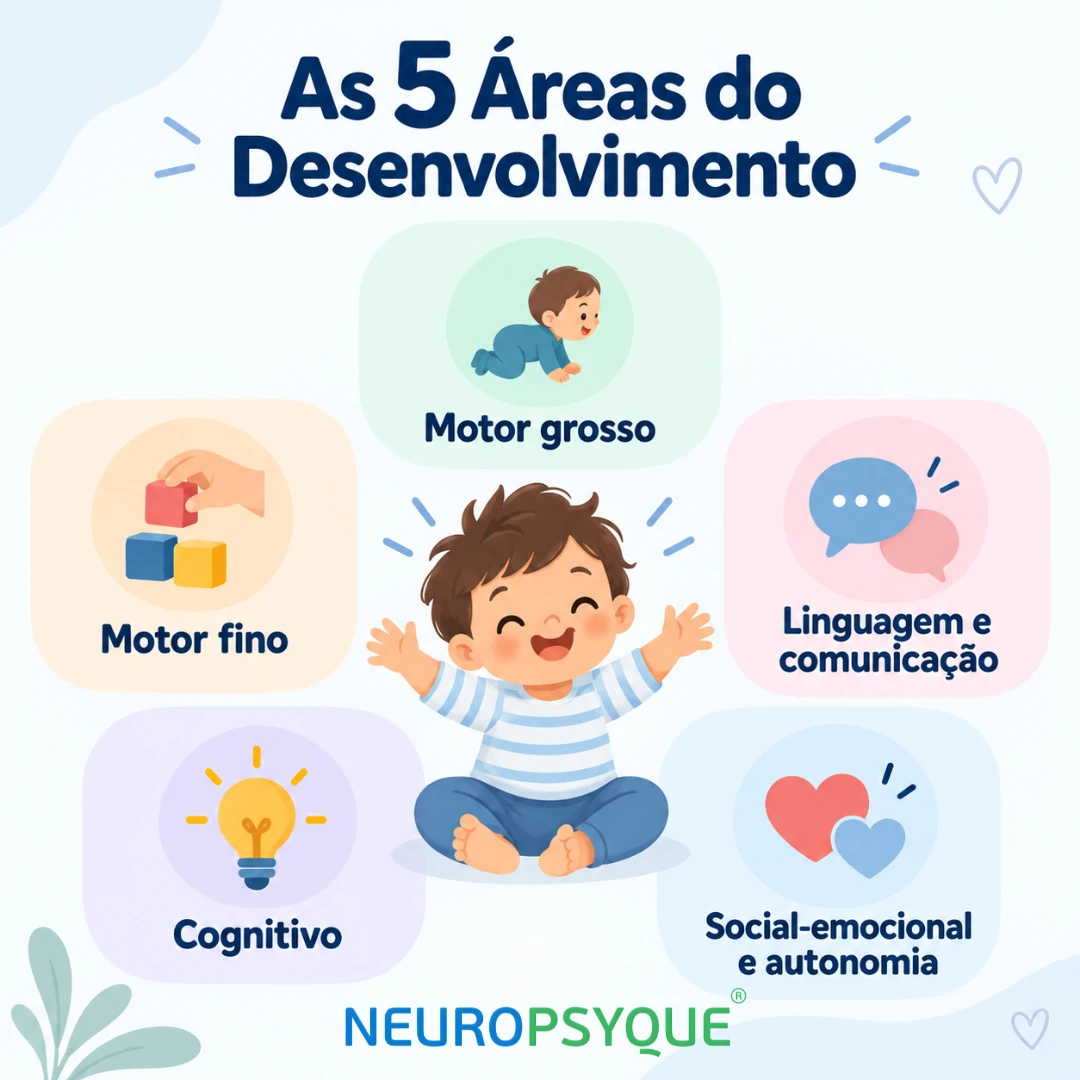
A child does not develop as a single, unified whole. Professionals observe 5 domains in parallel, each with its own indicators.
- Gross motor development — major body movements: holding up the head, sitting, crawling, walking, running.
- Fine Motor Skills — manual dexterity: grasping, pinching with the thumb and forefinger, stacking, scribbling.
- Language Development and Communication — it’s not just about talking. It includes what the child comprises, gestures, pointing and eye contact.
- Cognitive Development — solving simple problems, imitating, realising that an object continues to exist even when it is out of sight, playing make-believe.
- Social-emotional and Autonomy Development — social smiling, showing an interest in other children, eating on their own, getting dressed with a bit of help.
This distinction is useful for a practical reason: It is quite common for a child to make rapid progress in one area and slower progress in another.
Many babies who are late to walk start talking early — and vice versa.
What is a cause for concern It is not a slower area, but a delay that occurs in various areas at the same time.
Age-Specific Developmental Milestone Tables
The ages shown in the tables below are average figures, not mandatory dates.
Motor Development
| Age | Motor (Coarse and Fine) |
|---|---|
| 0–2 months | Reflex movements; briefly lifts the head whilst lying face down |
| 2–4 months | Hold your head up; open your hands |
| 4–6 months | Rolls over; sits with support; grasps objects |
| 6–9 months | He sits on his own; he starts to crawl |
| 9–12 months | Stands up with support; does the pincer |
| 12–18 months | Walks on his own; crouches down; stacks blocks |
| 18–24 months | Runs; climbs stairs with help; scribbles |
| 2–3 years | Jump with both feet; alternate your feet on the stairs |
Language and Communication
| Age | Language and communication |
|---|---|
| 0–2 months | He cries in different ways; he is startled by loud noises |
| 2–4 months | Coos; he turns towards the voice |
| 4–6 months | Babbles (“ba-ba”); roars with laughter |
| 6–9 months | Responds to their name; puts syllables together |
| 9–12 months | “Mum”/”Dad” (said with a particular meaning); points |
| 12–18 months | First words; follows simple instructions |
| 18–24 months | Put two words together (“dá água”) |
| 2–3 years | Three-word sentences; asks questions |
Social and Cognitive Development
| Age | Social and cognitive |
|---|---|
| 0–2 months | He stares at her face from close up; he calms down in her lap |
| 2–4 months | Social smile; follows objects with his eyes |
| 4–6 months | Recognises familiar faces; puts everything in its mouth |
| 6–9 months | Look for the object that fell; be wary of strangers |
| 9–12 months | Imitates gestures (waving goodbye); plays hide-and-seek |
| 12–18 months | Imitates everyday tasks; eats with a spoon |
| 18–24 months | Plays make-believe; points out parts of the body |
| 2–3 years | Have a go with other children; recognises colours |
The First Year: From Reflexes to First Steps
A newborn who reacts only through reflexes becomes, within 12 months, a baby who moves about, communicates and interacts.
Newborn (0–2 months)
The first few weeks seem to lack any milestones — but they have.
A baby is born with primitive reflexes: sucking, grasping (clenching the hand around whatever touches the palm) and the Moro reflex (spreads his arms when he gets scared).
These reflexes are, in themselves, signs of a nervous system functioning properly, and gradually disappear as voluntary movements take their place.
The baby can to stare intently at close range (about 30 cm, the ideal distance from one’s lap), is startled by sudden noises and cries with different intensities and tones as and when needed — whether it’s hunger, colic or tiredness.

First few months (2–4 months)
Here comes the social smile — the baby smiles in response to anyone who speaks to them —, holds their head up whilst lying on their front, follows objects and people with their eyes, reacts to sounds, and makes their first sounds too — the so-called coos .
Halfway through the year (4–6 months)
The baby rolls over, sits up (first with support and then unaided), grabs objects and puts them in their mouth, and responds with laughter and babbling (“ba-ba”, which still has no meaning). They recognise familiar faces.
End of the first year (9–12 months)
Many babies crawl, stand up with support, and take steps whilst holding onto furniture. They do the “tweezers” using their thumb and forefinger, they point at what they want, respond when called by name and say “mummy” or “daddy” deliberately. Many will take their first steps around their first birthday — but not all of them, and that’s normal.
From 12 to 24 Months: Walking and First Words
The second year is the year of motor independence and a surge in communication — and the stage when the most questions arise, because there is such a huge variation between children.
- Motor Skills: The child begins to walk unaided — most between 12 and 15 months, though it is quite normal for this to happen as late as 18 months —, then climbs, goes up stairs with help and runs. They stack blocks, scribble and eat more and more by themselves.
- Language: their first words, a gradual increase in vocabulary at first, followed by a sudden surge; at 18–24 months, they combine two words (“give water”). They understand far more than they say.
- Social: They imitate everyday tasks, play “pretend” and assert their will — the famous ‘terrible twos’ are, in themselves, an emotional milestone.
Ages 2 to 3: Language and Independence
Between the ages of two and three, a child consolidates what they have learnt.
A language It’s a big leap: their vocabulary grows rapidly, their sentences get longer, questions start to appear (“why?”) and what they say becomes understandable to people outside the family.
When this progression it doesn’t happen, this may be a case of a language disorder — which has its own assessment and intervention procedures.
On the plan engine, runs safely, jumps with both feet, alternates feet on the stairs and develops fine motor skills in hand movements.
On the plan cognitive and social, plays elaborate make-believe games, starts to play with other children and is moving towards independence in their daily routines — getting dressed with help, toilet training (some children no longer need nappies), etc.
Why Milestones Are Timeframes, Not Exact Dates
This is the most important point of the article — and it is not a reassuring thought: it is a fact.
O a multicentre study by the World Health Organisation followed hundreds of healthy children in six countries and established “transfer windows” for the key milestones. The figures speak for themselves:
- Sitting without support: between 3.8 and 9.2 months
- Crawling: between 5.2 and 13.5 months
- Standing up on one’s own: between 6.9 and 16.9 months
- Walking on your own: between 8.2 and 17.6 months
In other words: the normal range for walking spans more than nine months. Two children who are equally healthy can differ by almost a year in this skill.
And there is another telling figure from the same study — around 4%: the children never used to crawl on all fours, moving straight on to another form of transport. It is not a deviation from the route: it is a normal variant.
For babies born prematurely, development is assessed up to the age of 2 by age-adjusted (calculated from the date on which the baby was due).
One a single milestone A delay is almost never a cause for alarm.
There are three things worth noting:
- The standard: several delays in one go;
- Significant delay: a delay that clearly exceeds the specified limit;
- Regression: a skill that is being lost.
If you have any queries, The person to contact is the paediatrician — and, where a specialist assessment is warranted, the evaluation of the neurodevelopment in children and young people enables each milestone to be placed within the overall context and intervene at an early stage.
Monitoring Appointments: Where Milestones Are Assessed
In Portugal, monitoring a child’s development does not depend on the parents’ initiative: it is structured within the National Programme for Child and Youth Health from Directorate-General for Health.
Appointments are booked at key ages — in the first week of life and then at 1st, 2nd, 4th, 6th, 9th and 12th month, followed by the 15 e 18 months and the 2, 3, 4 and 5 years.
These dates are not arbitrary: they are deliberately timed to coincide with the moments when new landmarks are due to appear.
Please do not miss these appointments — the opportunity is missed to detect any differences in pace at an early stage, or to make adjustments to the stimuli provided to the child, at the stage when intervention has the greatest impact.
🧠 Key Points to Retain
- Developmental milestones are intended to provide guidance and help track progress — not to assess a child’s development on a specific day.
- Development is observed in five areas: gross motor skills, fine motor skills, language, cognitive and social-emotional.
- In their first year, babies progress from primitive reflexes to their first steps: social smiling, sitting up, crawling, the pincer grasp, and their first words.
- Between 12 and 24 months, children begin to walk unaided and put words together — this is the stage where there is the greatest variation amongst children.
- According to the WHO, the normal range for walking unaided is between 8.2 and 17.6 months — a span of more than nine months.
- Premature babies are assessed according to their corrected age up to the age of two; around 4% of children never crawled, and this is normal.
- What is of concern is the pattern — several delays occurring at the same time or any regression —, not an isolated incident.
- PNSIJ monitoring appointments are scheduled at the ages when new developmental milestones are expected to be reached.
FAQs - Frequently Asked Questions
At what age do children normally start walking?
The age at which a child starts walking varies between 8 months and 1½ years.
My son didn’t crawl; he went straight on to walking. Is that normal?
Yes. A WHO study showed that around 4% of healthy children did not crawl before walking — some drag themselves along whilst sitting, others roll, and others move straight into a standing position. What matters is that the child finds their own way of getting about and explores the space around them.
Should I compare his development with that of his older brother?
It is the most common mistake — and the one that causes the most unnecessary anxiety. Siblings share some of their genes and their environment, but their development may follow very different patterns, both of which are perfectly normal. The useful comparison is not with their sibling, but with the child’s own progress: are they making progress and acquiring new skills over time?
Are developmental milestones the same for all children?
The sequence is similar (almost all children sit up before walking and babble before speaking), but the pace varies greatly, and this variation is normal. The milestone charts describe averages, not individual requirements.
Do premature babies follow the same developmental milestones?
They continue to be counted from their corrected age — the date on which the baby was due to be born (estimated date of birth). A baby born two months prematurely will, at 12 months of age, have a corrected age of 10 months. This adjustment is used up to the age of two, by which time most premature babies catch up with their peers.
At what point should I start to worry about deviations from the benchmarks?
It depends on the area, age and the overall picture. Of greater concern are delays that clearly exceed the normal range, delays in several areas at the same time, and any regression. In such cases, do not wait to carry out an assessment.