Skip to content


Suspected Sleep Apnoea: When Should You Seek Medical Help?
Waking up tired every day, feeling constantly sleepy, or hearing a family member say that “hold your breath”during sleep are signs that should not be ignored.
If you’ve already read about the symptoms and causes of sleep apnoea and nocturnal dyspnoea and if you recognised some of them, this article is the next step: understand what happens once you arrive at the appointment, what tests are involved and what the results mean.
How is the initial clinical assessment for sleep apnoea carried out?
A specialist sleep consultation — usually with a neurologist or a neuropsychiatrist — is the starting point.
The doctor collects information about the sleeping habits, medical history e risk factors, and may appeal to STOP-BANG questionnaire: an internationally validated screening tool comprising eight objective criteria.
The acronym describes the criteria:
- to snore loudly (Snoring)
- daytime tiredness (Tired)
- pauses observed by others (Observed)
- high blood pressure (Pressure)
- High BMI (BMI)
- aged over 50 (Age)
- neck circumference over 40 cm (Neck)
- male (Gender)
A score of 3 or more positive criteria places the patient in the intermediate to high-risk category — and justifies further tests.
What is Polysomnography and How Does This Sleep Test Work?
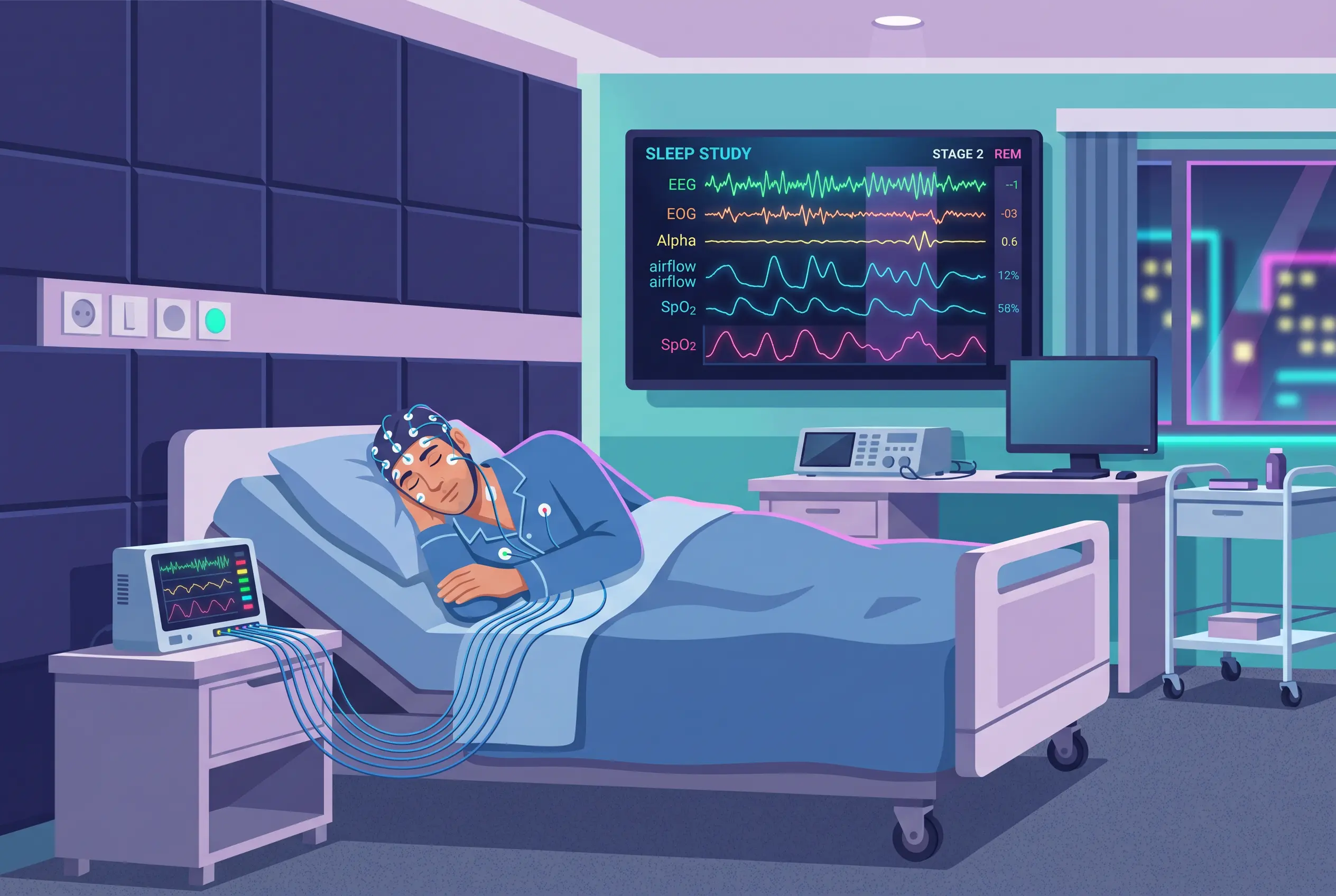
A polysomnography is the gold standard test for diagnosing apnoea — the so-called “gold standard” in the assessment of sleep-related breathing disorders.
Over the course of a whole night, it simultaneously records:
- brain activity (EEG)
- eye movements (EOG)
- muscle activity (EMG)
- heart rate
- nasal and oral airflow
- blood oxygen saturation
- respiratory effort and body position
The exam is completely non-invasive — all the sensors are placed on the surface of the body, and most people are able to fall asleep as normal.
Type 1, 2, 3 and 4 Polysomnography: What Is the Difference Between Them?
There are four types of polysomnography, classified by number of parameters monitored and by the venue. The choice depends on the clinical suspicion and the complexity of the case.
A type 1 is carried out in a sleep laboratory under the continuous supervision of a technician, recording at least 7 signal channels — brain activity, eye movements, muscle movements, heart rate, respiratory flow and oximetry. It is the study of greater sensitivity e lower failure rate, recommended in more complex cases or when other methods have proved inconclusive.
A type 2 monitors the same parameters as the Type 1 model — at least 7 channels — but is carried out at home, without the presence of a technician. It is the most comprehensive option for home-based monitoring, useful when the patient is unable to sleep in the laboratory but a more complex condition is suspected.
A type 3 — also known as cardiorespiratory polygraphy — records between 4 and 7 channels, no brain activity detected. The focus is on assessing obstructive sleep apnoea: it monitors airflow, snoring, respiratory effort, oxygenation and body position. It is carried out at home and shorter waiting times and is sufficient to diagnose apnoea in most cases.
A type 4 uses only 1 or 2 channels — typically pulse oximetry (blood oxygen levels) and heart rate. It is the method more simplified, used as an initial screening tool or in specific contexts involving excessive sleepiness. It does not replace the previous classifications in the formal diagnosis of apnoea.
The doctor will advise on the most appropriate approach for each clinical situation.
What does the Apnoea-Hypopnoea Index (AHI) mean?
The key finding of polysomnography is the Apnoea-Hypopnoea Index (AHI) — the number of abnormal breathing events per hour of sleep. It is this figure that determines the severity and guides treatment:
- IAH less than 5 — normal
- IAH between 5 and 15 — mild apnoea
- IAH between 15 and 30 — moderate sleep apnoea
- IAH greater than 30 — severe apnoea
A hypopnoea This corresponds to a partial reduction in airflow — sufficient to lower blood oxygen saturation or trigger a micro-awake state, with a real impact on rest.
After the Diagnosis: What Are the Treatment Options for Sleep Apnoea?
Once the IAH has been determined, the doctor draws up a treatment plan. To moderate to severe sleep apnoea, the first-line treatment is CPAP (Continuous Positive Airway Pressure) — a nasal mask that keeps the airways open by delivering a flow of pressurised air.
In Portugal, it is fully funded by the NHS in cases where there is a clinical indication.
To mild apnoea, or when CPAP is not tolerated, there are alternatives: mandibular advancement prostheses, surgical procedure in cases of specific anatomical obstruction, and lifestyle changes.
Losing weight, avoiding alcohol in the evening, and sleeping on your side can significantly reduce OSA.
The Neurological Impact of Untreated Sleep Apnoea: Why a Comprehensive Assessment Is Important
Sleep apnoea it is not just a respiratory problem. Each episode causes a drop in oxygen levels and a micro-awakening of the brain — imperceptible on its own, but very harmful to health in the long term.
Over time, memory problems, slower cognitive processing, difficulty concentrating and emotional instability may develop.
In NeuroPsyque, each case is assessed holistically, with particular attention paid to neurological consequences. The Neurofeedback can be used as a complement to conventional treatment, training the brain to establish more stable and restorative sleep patterns, thereby avoiding the problem of becoming dependent on sleeping pills.
🧠 Key Points to Retain
- The rate of underdiagnosis of sleep apnoea in Portugal is around 80% — the majority of cases are never assessed.
- The STOP-BANG questionnaire comprises eight objective criteria; a score of ≥3 warrants further investigation.
- Polysomnography simultaneously monitors brain, heart and respiratory activity — it is the gold standard test for diagnosis.
- It can be carried out in a laboratory (type 1) or at home using a portable device (type 3), as directed by a doctor.
- The IAH classifies severity as mild (5–15), moderate (15–30) or severe (>30) — and directly guides the choice of treatment.
- CPAP is covered by the National Health Service in Portugal; for mild sleep apnoea, mandibular advancement devices and lifestyle changes are valid alternatives.
- Untreated sleep apnoea has a progressive neurological impact — the comprehensive assessment at NeuroPsyque includes an evaluation of the cognitive effects.
FAQs - Frequently Asked Questions
What is the STOP-BANG questionnaire and how is it used in diagnosis?
It is a screening tool based on eight objective clinical criteria, used during consultations to estimate the likelihood of sleep apnoea before proceeding to further tests. A score of 3 or more indicates an intermediate to high risk.
How long does a polysomnography take?
The test takes place over a full night. In the home version (type 3), the patient fits the device at home and returns it the following day. The results are available within a few working days.
Is home polysomnography as reliable as laboratory-based polysomnography?
For the diagnosis of apnoea without complex comorbidities, type 3 has comparable sensitivity. Where other sleep disorders are suspected, a laboratory study is preferable as it monitors more parameters.
Is CPAP covered by the National Health Service in Portugal?
Yes, in all cases where there is a clinical indication — moderate to severe sleep apnoea confirmed by polysomnography. The process involves a medical prescription and follow-up by an accredited organisation.
Can mild sleep apnoea be treated without CPAP?
In many cases, yes. Losing weight, avoiding alcohol in the evening and sleeping on your side can significantly reduce OSA. Mandibular advancement devices are equally effective for mild to moderate apnoea.