Skip to content


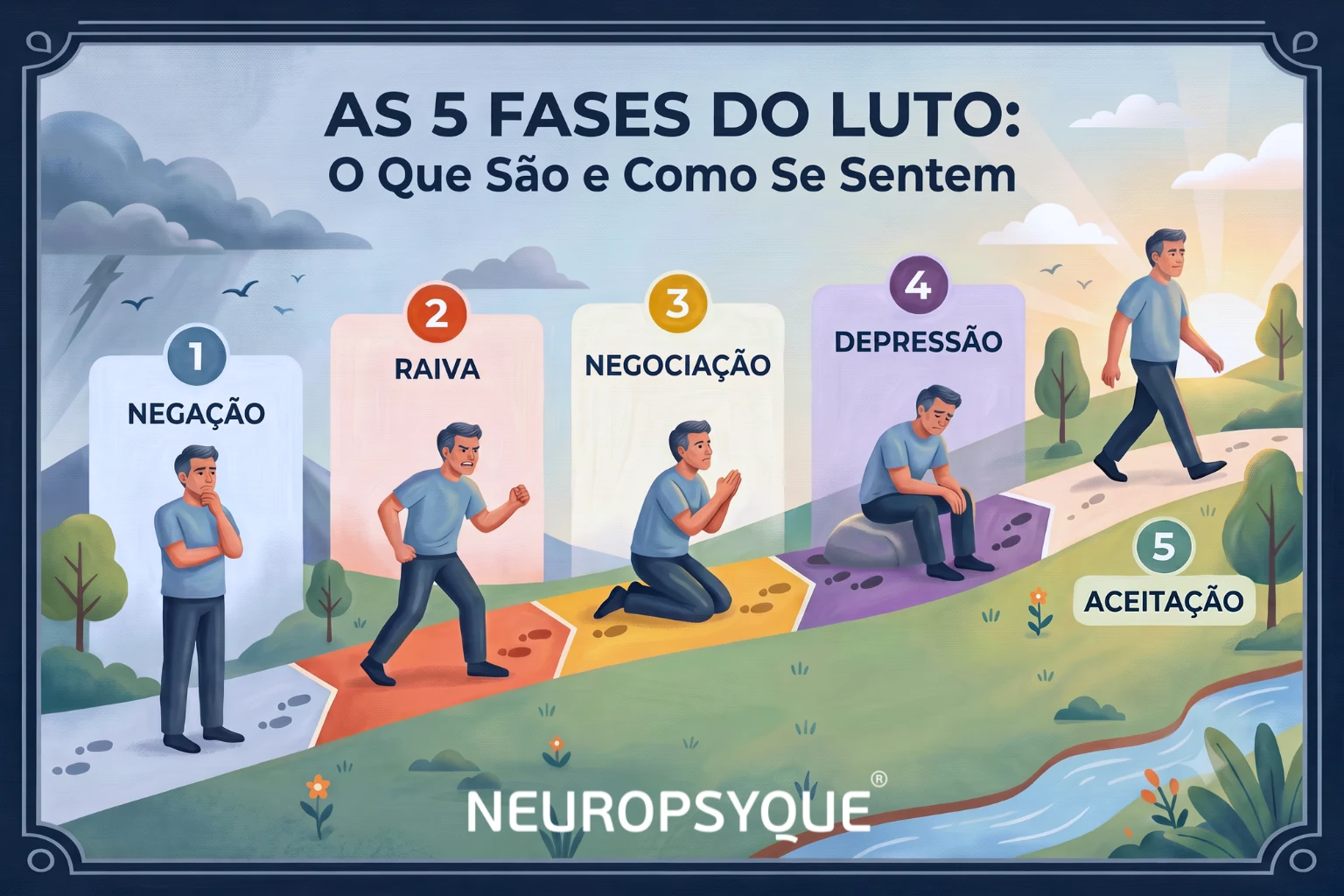
The 5 stages of grief
1. Negation
Denial is common in many cases following a significant loss.
It tends to be the first shock absorber.
In this state, the mind refuses, for a few moments, or for days, to believe what had happened.
It feels like a sort of film playing out right beside us — unreality, numbness, a “This can’t be happening” which repeats itself endlessly.
Many people describe At this stage, they operate “on autopilot”: they deal with formalities, receive visitors and reply to messages, without the news seeming to have fully arrived to the body.
Denial It’s not about pretending nothing happened — it is the way in which the mind processes a reality that is too vast to be taken in all at once.
2. Anger
When the denial begins to wane, reality hits hard — and it often comes hand in hand with outrage.
You may feel anger towards the illness, the doctors, the person who has passed away, yourself, or simply a sense of injustice.
The body follows: tension in the jaw or chest, impatience, irritability towards those around you.
This is one of the most stigmatised reactions grief — many people feel it but hide it, for fear of appearing “ungrateful” or “out of control”.
It is, nevertheless, a normal response for fear of losing control over something as fundamental as the life of a loved one.
3. Negotiation
Negotiation is a state characterised by introspection and, in some cases, ruminating on specific ideas.
It is the territory of the “what if”: What if we’d gone to the doctor sooner? What if I’d phoned that night? What if I’d pushed harder? What if I’d been there?.
The mind, when faced with profound pain, the loss of control, and in some cases a sense of guilt, tries to find a way to regain some sense of control.
It feels like an obsessive “why”, a replay a mental ‘review’ of the past few days or months, often accompanied by guilt and thoughts that are hard to shake off, especially at night.
4. Depression
Here, sadness no longer comes in waves; it simply remains.
To be a constant background.
It is not the same type of depression found in other conditions, such as major depressive disorder. It is the deep sadness felt by those who has come to realise, in their body and not just in their mind, that the loss is permanent.
It feels like a void: a tiredness that sleep doesn’t take away, a lack of motivation for tasks that used to come naturally, and tears that well up without warning.
It is the stage that is closer to the image we have of mourning — and for many people, the longest.
5. Acceptance
This is always the final stage.
Accept it isn't come to terms with what happened, nor will I ever stop missing you.
Above all, it feels like a sense of relief (to a greater or lesser extent) from a great burden: the days are regaining their structure, there’s room to think about other things, plans for the future start to make sense again, and it becomes possible to talk about the person who has gone with more longing than acute pain.
She remains in our memory — but it no longer takes up so much space that it makes it impossible to carry on with life: carry on walking.
It’s about learning to live in this new reality, without that erasing the relationship that once existed.
Where does this model come from (and what are its limitations)?
O five-stage model was proposed by Elisabeth Kübler-Ross in the 1960s, through the care of terminally ill patients — people who were facing their own death, not that of someone else.
It was only later that it was extended to those who remain: to those who lose someone they love. This background helps to explain its limitations and how it should be read today.
The value of this model lies in putting a name to reactions that might otherwise be frightening.
Anyone who feels anger after losing their father, or spends weeks going about their business “on autopilot” as if nothing had happened, You can find an explanation here: these emotions and behaviours have names; they are common, and other people inevitably experience them too.
O limit It’s a matter of taking it literally.
A Research shows that Most people do not go through the five stages, let alone in that order.
There is no set order, nor are there any compulsory stages, and There is no formula for defining what acceptance is, at the end.
Using the model as a standard — “I’m still in the anger stage; I should be at the acceptance stage by now” — adds to the blame to those who are already suffering, the opposite of what Kübler-Ross intended.
Because grief is not a linear process
If there is one thing to take away from this article, it is this:
“True grief is less like a staircase and more like the tide.”.“
The pain comes in waves — there are better days, and then there are days when it all comes back with a vengeance, often without warning.
A piece of music, a smell, or a date can bring back emotions. Reliving a phase isn’t a step backwards; it’s the natural way in which the mind comes to terms with loss.
It is also common to experience several reactions at the same time — sadness and anger, longing and relief, denial in one respect and acceptance in another.
There are people who never feel anger or go through a clear phase of denial, and who grieve in a perfectly healthy way.
What the science and medical practice What they describe is precisely this: a a natural ebb and flow between moments centred on pain and moments centred on life which continues, with the waves becoming more widely spaced over time.
A duration This process varies greatly from person to person.
When the phases go on for too long
In majority For most people, the pain gradually eases over the course of several months.
Mourning doesn't have a stopwatch, but there is a direction: however much it hurts, the trend is towards a gradual return to normality — back to work, to relationships, to finding some pleasure in things.
That’s the one direction, rather than the timeline, which distinguishes normal mourning – which runs its course – from a pathological bereavement.
No pathological bereavement, the person remains, many months later, just as incapacitated as they were in the first few weeks.
Life hangs in the balance in the wake of loss; the isolation is increasing rather than decreasing.
In such cases, we are no longer talking about a “longer phase”, but possibly a period of bereavement that requires more careful and close support.
Distinguishing between normal and pathological grief in the surgery, in the Psychiatry consultation, is the next step — seek expert advice It’s not a sign of weakness: this is how to unblock a process that has become stuck.
🧠 Key Points to Retain
- The five stages of grief — denial, anger, bargaining, depression and acceptance — describe common reactions, not mandatory stages.
- Each stage is experienced in its own way: from the unreality of denial to the sense of relief that comes with acceptance, via anger, the “what ifs” and the emptiness.
- The model of Kübler-Ross It is useful for putting a name to what one feels; it should not be used as a standard for “proper” mourning.
- True grief is not a linear process: it comes in waves, and it is perfectly fine to repeat or skip stages.
- What is important to bear in mind is not the order of the stages, but the direction: over time, the pain should subside and normal function should return.
- When grief becomes stuck and hinders one’s life for many months, it may be pathological grief — and this can be assessed and treated.
FAQs - Frequently Asked Questions
Do I have to go through all the stages?
No. Research shows that most people do not go through all five stages, let alone in the classic order. There are healthy ways of grieving that involve no visible anger, no obvious denial or no distinct depressive phase. The stages are a framework for recognising common reactions — not a checklist.
Is it normal to skip stages or repeat them?
Yes, and it happens to most people. Grief comes in waves: you may feel that you’d already “come to terms with it”, and then, months later, a particular date or memory brings back feelings of anger or tears. This isn’t a relapse or a step backwards — it’s the natural way in which the mind continues to come to terms with the loss. Over time, these waves tend to become less frequent and lose their intensity.
When do the phases indicate a problem?
More important than the stage you are at is the overall course of your grief. If, many months after the loss, the pain remains as intense as it was in the first few weeks, life continues to feel on hold, isolation increases, or thoughts of a complete loss of interest in life arise, these are signs that your grief may have become complicated. In such cases, it is important to seek specialist assessment — pathological grief can be effectively treated, and seeking help early on shortens the period of suffering.