Skip to content



Facial Tics in Adults: More Common Than You Might Think
Blinking repeatedly. Wrinkling your nose. Unintentionally pulling up one corner of your mouth. The facial tics are, of all types of tics engines, those that have the greatest impact on self-esteem, and they are more common than you might think.
1 in 5 school-age children have some form of tic — and facial tics are the most common. In most cases, they resolve themselves. When they persist into adulthood, they may be isolated tics, a sign of a chronic disorder or, in more complex cases, of Tourette's Syndrome — which involves multiple motor tics and at least one vocal tic.
The focus is on: The What, specifically, can be done to control them?
The Impulse That Precedes the Tic — and Why It’s Beneficial for Treatment
Before you can understand how to control facial tics, you need to be aware of a phenomenon that most people experience but few can put a name to: the premonitory impulse.
This is a growing tension — located in the affected area of the face — which precedes the tic and is momentarily relieved by movement.
It is comparable to need blinking when your eyes are dry:
- uncomfortable
- urgent
- relieved by the act itself
If there is a moment before of the ticket, there is a window of opportunity — and that’s where the behavioural therapies the most effective ones operate.

Habit Reversal Training: The Approach with the Most Scientific Evidence
O Habit Reversal Training (HRT) It is considered the first-line behavioural treatment for tics by the leading international clinical guidelines.
A a meta-analysis comprising 18 studies and 575 participants has proven its effectiveness — with significant reductions in frequency e intensity ticks in children and adults.
The principle: rather than giving in to the premonitory impulse, the person learns to replace it with a concurrent behaviour: a gesture volunteer e incompatible (which does not allow simultaneous ticketing).
With repetition, the brain incorporates this new standard. It is the neuroplasticity of the brain used for therapeutic purposes.
How it works in practice
The process consists of three steps:
- Recognising the impulse: identify the tension that precedes the twitch, before the movement occurs.
- Execute the concurrent behaviour: a movement that uses the same muscles in a controlled way. Those who blink involuntarily can learn to apply gentle pressure to their eyelids; those who wrinkle their nose can redirect this into slow nasal breathing.
- Hold for 1 minute: enough time for the impulse to fade away before the tic manifests itself.
The results tend to be long-lasting and superior to most pharmacological approaches in the long term.
Stress Management: It’s Not Enough to Know It Gets Worse — You Have to Take Action
O stress doesn't cause tics, but amplifies them.
During periods of greater emotional strain, the brain circuits involved become more unstable — and the tics become more frequent.
Here are some key points on managing stress:
- Diaphragmatic breathing: Breathe in through your nose for 4 seconds, allowing your stomach to expand, then breathe out through your mouth for 6 seconds. Ten minutes a day reduces the activity of the autonomic nervous system — the same system that exacerbates tics.
- Mindfulness: practices of mindfulness, without distractions, even if they are short (5 to 10 minutes), reduce stress reactivity and improve the ability to recognise the warning signs before acting.
- Good quality sleep: Sleep deprivation directly increases the frequency of tics. Aiming for 6 to 9 hours of sleep per night is also a management strategy.
Medical and Neurotherapeutic Options: What’s Available and Who They’re For
When facial tics are persistent or cause suffering, the options are more extensive than most people realise.
Botulinum toxin (Botox)
A injection into the affected muscle blocks the nerve impulses responsible for involuntary movement, with an effect lasting between 3 to 6 months. A good option for facial tics, which is well tolerated when administered by an experienced practitioner.
Neurofeedback
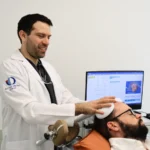
O Neurofeedback is a non-invasive technique in which the brain learns to regulate its own electrical activity in real time. It tackles the root of the problem and is highly effective, including in difficult cases compared with conventional treatment.
Transcranial Magnetic Stimulation (TMS)
A TMS acts on the relevant cortical circuits, with documented benefits in terms of the frequency and intensity of tics, without the adverse effects of long-term medication.
When Facial Tics Require Specialist Assessment
If the ticks:
- have persisted for over a year,
- cause pain,
- restrict one’s social life, or
- are associated with severe anxiety
So a consultation is essential. A early intervention, ... when done at the right time, it makes a real difference to the results.
🧠 Key Points to Retain
- The premonitory urge — the tension that precedes the tic — is the window of opportunity in which behavioural therapies take effect.
- Habit Reversal Training (HRT) is the approach with the strongest scientific evidence: it teaches the brain to replace the tic with a voluntary competing behaviour.
- Stress exacerbates tics — diaphragmatic breathing, mindfulness and quality sleep are complementary strategies that make a real difference.
- Botulinum toxin is an effective yet underused treatment option for focal facial tics, subject to medical advice.
- Neurofeedback has been shown to be effective even in cases that are resistant to conventional treatment.
- Tics that persist for more than a year or affect quality of life warrant specialist assessment.
FAQs – Frequently Asked Questions
Can the Habit Reversal Programme be done at home?
To some extent. The basic principles can be learnt independently, but the best results are achieved with professional guidance in the early stages — a therapist helps you choose the right competing behaviour for each tic. Guidance is particularly important at the outset to avoid frustration with the method, which is effective.
Does botulinum toxin for facial tics have any side effects?
When administered by an experienced practitioner, the effects are mild and temporary — such as slight muscle weakness in the treated area. The effects last for 3 to 6 months and the treatment can be repeated.
Are facial tics in adults different from those in children?
The neurobiology is the same. In children, many transient tics disappear during adolescence. In adults, those that persist tend to be more chronic — but they still respond well to treatment.
How long does it take for neurofeedback to have an effect on tics?
The first results typically become apparent between the 8th and 12th session. Full treatment programmes involve between 20 and 40 sessions, with the benefits becoming more established over time.
Can facial tics return once they have been brought under control?
They can, particularly during periods of high stress or sleep deprivation. Stress management and good sleep habits are part of the long-term management plan.