Skip to content



The Specialist You Should Book an Appointment With to Assess Memory Problems
When your memory starts to fail you more than you’d like, you sometimes find yourself wondering who to turn to.
GP? General practitioner? Neurologist? Psychiatrist? Psychologist? Neuropsychologist?
The answer depends on the type of faults observed and the associated symptoms. Choosing the right course of action from the outset saves time, resources and unnecessary anxiety.
This article has a specific aim: to help him realise which specialisms are right for you — and in what order it is best to look for them.
Before Booking an Appointment: What You Need to Know About Reversible Causes
Many people have fear that memory failures may be an early sign of dementia (e.g. Alzheimer's disease).
However, the most of the memory errors it is not of neurodegenerative origin (progressive and irreversible loss of the structure and function of neurons).
Some of the most common reasons for forgetting things are:
- Chronic stress
- depression
- sleep deprivation
- vitamin B12 deficiency
- hypothyroidism
With the right treatment, these causes are reversible.
Figuring out whether any of these causes lie behind the forgetfulness is the first step of any clinical assessment.
Before any specialist diagnosis is made, blood tests — vitamin B12, thyroid function, metabolic markers — can identify simple causes that explain what appears to be a serious neurological problem.
O GP You can and should ask for them.

The Consultation Process: Which Specialist to See and When
GP: always the first step
Regardless of the symptoms, a consultation with your GP is, if possible, the recommended first step.
The GP assesses the simpler global context (current medication, emotional state, medical history, etc.), orders the initial tests and may refer the patient to the appropriate specialist.
In some cases, the cause is identified and resolved here.
Neurologist or neuropsychiatrist: progressive deterioration or suspected organic cause
O neurologist He is the go-to specialist when memory loss is progressive, affects a person’s independence, or when initial tests indicate changes in the brain.
- Assesses the neurological pathways;
- Requests neuroimaging where necessary (MRI, CT scan);
- It establishes the differential diagnosis between normal ageing, mild cognitive impairment and dementia.
He is also the specialist to consult in cases of sudden memory loss or accompanied by other neurological symptoms.
When the memory errors occur alongside anxiety, low mood, insomnia or significant emotional distress, the neuropsychiatry It is the most comprehensive specialism.
It deals with the component at the same time neurological e mental — essential because these dimensions feed off one another mutually and are rarely resolved separately.
Neuropsychologist: pinpointing exactly what is going wrong
A neuropsychological assessment It’s not a doctor’s appointment — it’s a diagnostic tool (very important).
Using standardised tests, it accurately identifies which cognitive functions are affected (memory, attention, language, executive functions) and in which degree.
It is essential when the diagnosis is uncertain, or when one wishes to to distinguish between normal age-related decline and pathological impairment, or to draw up a plan for cognitive rehabilitation.
When to See a Specialist Directly — Without Going via Your GP
There are situations in which the the urgency of diagnosis justifies bypassing the usual screening process and booking an appointment directly with a neurologist or neuropsychiatrist:
- Memory loss sudden or which has taken hold over the course of days or weeks
- Disorientation in familiar places
- Difficulty in recognising close friends and family
- Faults accompanied by language changes, vision or balance
- Changes in personality or behaviour noted by the family
These signs may indicate conditions that warrant prompt assessment.
Treatments Other Than Medication
Once the cause has been identified, the treatment plan goes far beyond pharmacology.
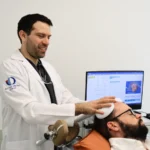
A Transcranial Magnetic Stimulation (TMS) has documented results in the improvement in cognitive functions, particularly when the case involves depression or cortical dysregulation.
O Neurofeedback It may also be helpful in stabilising patterns of brain activity associated with the memory processinga, and improving the ability to to encode e retrieve information.
Treatment should always to look at a person as a whole and tackle the root causes of the problem, with the cognitive work carried out by the neuropsychologist at the centre, and other therapeutic approaches that help to rehabilitate the memory, o reasoning and overall brain capacity.
🧠 Key Points to Retain
- The GP is usually the first port of call: they assess the overall situation, order tests to rule out reversible causes, and refer the patient to the appropriate specialist.
- A neurologist should be consulted when symptoms are progressive, affect a person’s ability to look after themselves, or where a structural cause in the brain is suspected.
- A neuropsychiatrist is the specialist to consult when memory problems occur alongside anxiety, depression or sleep disorders.
- Neuropsychological assessment is the most accurate tool for mapping a person’s cognitive profile — and is essential in cases of uncertain diagnosis or when planning rehabilitation.
- Sudden memory loss, disorientation in familiar surroundings or changes in speech warrant immediate and urgent specialist assessment.
- EMT, neurofeedback and cognitive rehabilitation are therapeutic options with documented results, with medication used as a complementary treatment.
FAQs – Frequently Asked Questions
Which department should I book an appointment with for memory problems?
It depends on the associated symptoms. If the symptoms are accompanied by anxiety, low mood or insomnia, a neuropsychiatrist is the most appropriate choice. If they are progressive and affect your ability to look after yourself without any apparent emotional component, start by seeing a neurologist. In any case, your GP is always a good place to start.
Should I have a neuropsychological assessment before seeing the doctor?
Not necessarily. A neuropsychological assessment is usually requested by a specialist doctor when they need to accurately identify which cognitive functions are affected. In some cases, it can be carried out independently as a starting point — but ideally it should form part of an assessment plan guided by a specialist.
Do memory lapses caused by depression improve with treatment?
Yes, often completely. Depression can cause symptoms that mimic dementia — slow thinking, forgetfulness, difficulty concentrating. When depression is treated, cognitive function tends to recover without the need for further intervention to improve memory.
Can neurofeedback help with memory lapses?
Yes, especially when these difficulties are linked to attention deficits, anxiety or dysregulated brain activity patterns. By stabilising these patterns, neurofeedback improves the ability to focus — the first prerequisite for memory to function properly.
How long does it take to get a diagnosis?
It depends on the cause and the course of treatment. Reversible causes such as hypothyroidism or vitamin B12 deficiency can be identified in an initial round of tests. More complex diagnoses — such as mild cognitive impairment or early-onset dementia — may require neuropsychological assessment, neuroimaging and more than one consultation.