

If you've ever experienced a panic attack, you know that the experience is overwhelming. Your heart races, your breathing fails, your body shakes and your mind screams that something terrible is about to happen. And in the midst of it all, a question looms: why is my body doing this to me?
The answer lies in the brain. And understanding it could be the first step towards regaining control.
Why Does the Brain “Set Off the Alarm” for No Reason?
Imagine that your brain has an internal alarm system - a biological smoke detector that has evolved to protect us from real threats. When it detects danger, it triggers the “fight-or-flight” response: the body prepares to face the threat or run away from it.
The problem? In a panic attack, this alarm goes off without any real danger. A perfectly normal bodily sensation - in this case, a slightly faster heartbeat - is interpreted as a sign of catastrophe. And from there, a cascade of events is triggered that turn seconds into eternities.
The Brain Structures Involved
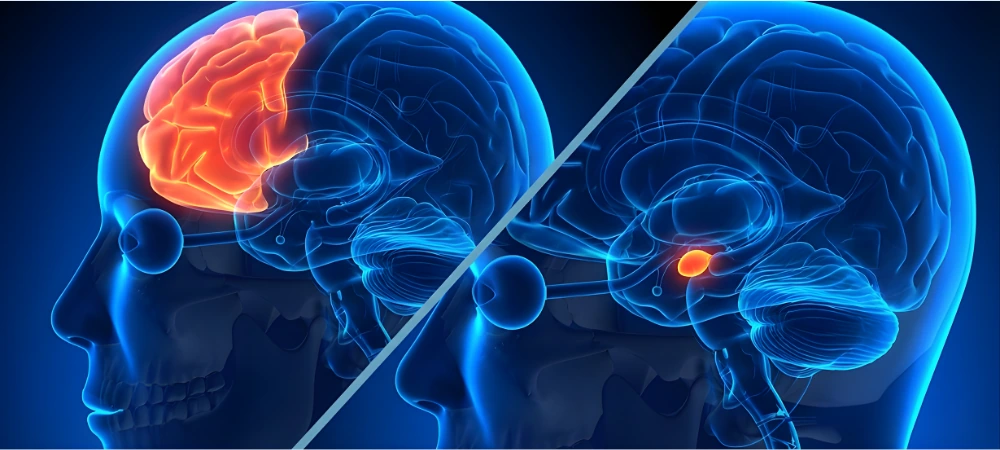
The Amygdala - The Overactive Alarm System
The amygdala is a small structure that functions as a fear processing centre. During a crisis, it becomes hyperactive, interpreting harmless internal signals as serious threats. It's like having a smoke detector so sensitive that it goes off every time someone heats up dinner.
The Prefrontal Cortex - The Failing Brake
The prefrontal cortex is responsible for rational thought and emotional regulation. Normally, it “calms” the amygdala when it overreacts. But during a panic attack, it reduces its activity just when we need it most. That's why it seems impossible to “think rationally” - the brake stops working.
The Chemical Cascade
Underneath these structures is a chemical storm. Noradrenaline, the hormone responsible for “agitating” the body when the need arises, shoots up to high levels, causing a racing heart, sweating and tremors. GABA - the brain's “natural tranquilliser” - seems to be in short supply in these situations. The hypothalamus, which produces neurotransmitters to respond to the environment, activates the release of adrenaline and cortisol, which are responsible for feelings of stress. This explosive combination produces the intense physical symptoms that characterise a crisis.
Chronology of a Crisis
In the first ten seconds, the amygdala detects a “threat” - often a trivial bodily sensation. Adrenaline begins to flood the system. Between thirty seconds and a minute, catastrophic thoughts arise: “I'm going to die”, “I'm going mad”. Hyperventilation (gasping for breath) causes tingling and dizziness, fuelling and exacerbating the cycle.
The peak of the crisis occurs between 1 and 5 minutes, when the physical and emotional symptoms are at their maximum. Then, gradually, the parasympathetic (“calming”) nervous system takes over. Between 5 and 20 minutes, the symptoms subside, leaving exhaustion and tiredness, and a fear that it will happen again.
What Happens When Crises Repeat?
When crises recur without treatment, the fear circuit can become more sensitive. It's as if the alarm threshold is lowered, requiring smaller and smaller stimuli to go off. It takes less and less “smoke” for the alarm to go off. This phenomenon, known as “kindling“ means that each untreated crisis can set the stage for the next. That's why it's so important to seek specialised help as soon as possible.

The Good News: The Brain Can Recover
The same characteristic that allows the brain to “learn” panic also allows it to unlearn it. Neuroplasticity - the brain's ability to modify itself and create new connections - means that we are not stuck in developed patterns.
A Psychotherapy “reprogrammes” the circuits involved in panic. Mindfulness strengthens the connections between the prefrontal cortex and the amygdala, restoring the “brake”. And innovative neurotherapies such as Transcranial Magnetic Stimulation and Neurofeedback act directly on brain function, offering long-lasting results based on neuroplasticity, the brain's ability to create new connections between different structures.
Key Points To Retain
A panic attack is a real biological response - what you feel has a concrete neurological basis.
It's not just a feeling.
During a crisis, the amygdala becomes hyperactive while the prefrontal cortex reduces its function - this is why it seems impossible to “calm down”.
For this reason, asking the person to “calm down” doesn't usually have the desired effect.
The brain releases a cascade of chemical substances that produce the intense physical symptoms.
Repeated crises can sensitise the brain, making it more vulnerable.
Seek help without shame or fear.
Neuroplasticity offers hope: the brain can change and recover with the right treatment.
We just have to use the right tools.
Frequently Asked Questions
1. Can a panic attack cause permanent damage?
An isolated seizure does not usually cause permanent damage. Frequent untreated seizures can be associated with brain changes, but these are largely reversible thanks to neuroplasticity.
2. Why do I feel like I'm going to die, even though I know I'm not?
During the crisis, the prefrontal cortex reduces activity while the amygdala is on high alert. The “emotional” part temporarily dominates the “rational” one, making it difficult to apply logical knowledge.
3. Can seizures be cured?
Many people make a full and lasting recovery. The right treatment - Psychotherapy, Medication and/or Neurotherapy - offers excellent prospects for substantial improvement.
4. What is Neurotherapy?
These are techniques that directly modulate brain activity. A Transcranial Magnetic Stimulation uses magnetic fields to activate specific regions. O Neurofeedback allows you to regulate your own brain activity in real time. Both are non-invasive, painless and based on neuroplasticity.
5. Can I prevent a crisis when I feel it starting?
Yes. Slow, controlled breathing can activate the parasympathetic nervous system, which is reassuring. Recognising the signs and reminding yourself that “this will pass, I'm not in danger” also helps. With training, many people learn to stop crises in their early stages.