Skip to content


Why do some memories last a lifetime, while others are so fragile that we forget them after two or three days?
I'm sure you've forgotten where you left your keys. But perhaps you remember the smell of your grandparents' house from childhood. You don't have to strain your memory to ride a bike or drive a car after so many years of learning. But it may be difficult to memorise a telephone number.
These situations reveal something fascinating: our brain doesn't just have one drawer for memory - it has several types of memory, different systems, each with its own function.
Understanding how these systems work is the first step towards realising why certain memories seem fragile while others stand the test of time - and what we can do to protect them.
What is Memory?
Memory is the the brain's ability to encode, store and retrieve information. Without it, we wouldn't be able to learn from the past, plan for the future or recognise the people we love. Memory is one of the things that defines who we are.
But it's not a single file.
Imagine it as a library with several sections, each organised differently. This organisation allows the brain to be incredibly efficient: store urgent information in a quick access and archive lasting knowledge in deeper areas.
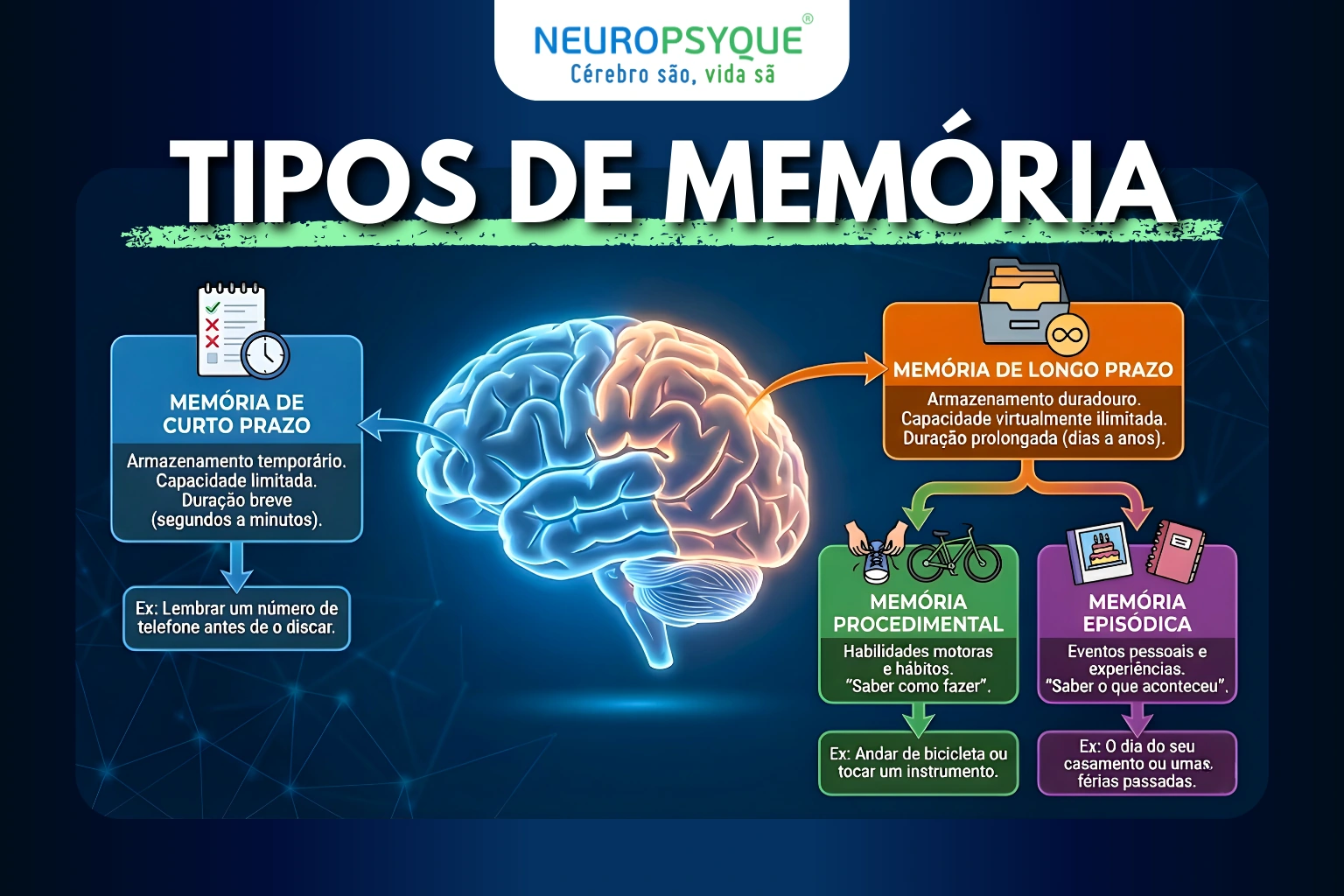
Short-Term Memory: The Mental Notepad
A short-term memory works like a temporary notebook. We were able to retain around 7 elements simultaneously, and the information remains accessible for only 15 to 30 seconds.
A classic examplesomeone tells us a telephone number and we repeat the number mentally until we write it down. If we are interrupted, the information disappears. This weakness is actually useful - the brain doesn't need to permanently store every piece of data it receives.
Long-Term Memory: The Permanent Archive
When information is sufficiently important or repeated, passes to long-term memory. This system has virtually unlimited capacity and can retain information throughout life.
Procedural Memory: “Knowing How”
A procedural memory (how to proceed) guard motor skills and habits - everything we know how to do without thinking. Riding a bike, driving or playing an instrument are perfect examples.
What makes this memory special is its resilience. Even people with severe amnesia often keep their procedural skills intact.
Episodic Memory: The Stories of Our Lives
A episodic memory is our autobiographical diary.
Saves personal events from the pastwedding day, summer holidays, first day at work, traumas, etc.
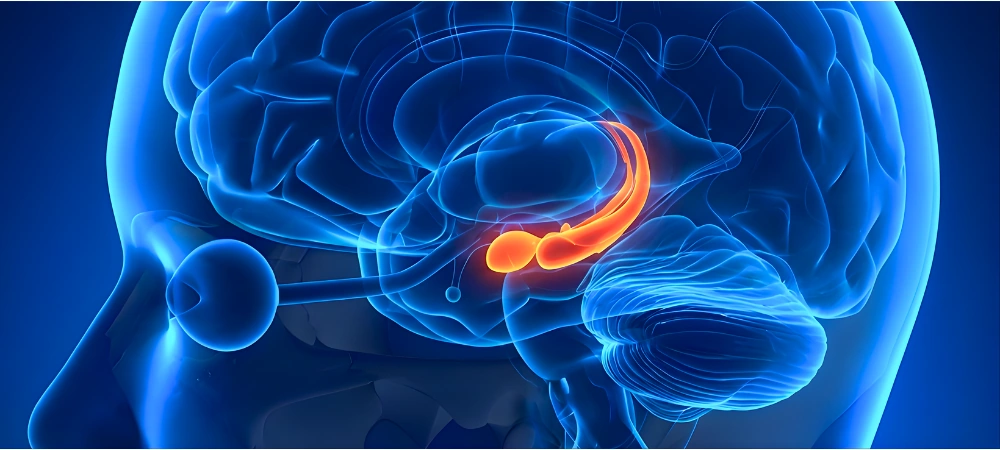
O hippocampus, The brain's seahorse-shaped structure is essential for these memories. It is also one of the first regions affected in Alzheimer's disease, For this reason, episodic memory problems are frequently the first symptoms.
Semantic Memory: Knowledge of the World
A semantic memory stores general knowledge: facts, concepts and vocabulary. Knowing that Paris is the capital of France or the meaning of “computer”, or “neuroplasticity”, are examples of this type of memory, which does not depend on the context in which it was learnt to exist and be remembered.
What Can I Do to Protect and Strengthen My Memory?
The good news is that memory is not a fixed resource - there is no limit that prevents us from creating new memories without forgetting others.
Thanks to neuroplasticity, we manage to create new connections throughout our lives, and we can always improve brain health.
Physical exercise deserves special mention here: people whose routine includes regular physical activity are always closer to ensuring brain health and memory maintenance. O quality sleep is another equally important aspect. It's during the deep stages of sleep that the brain consolidates all the memories of the day.
When Memory Needs Specialised Help
When persistent problems arise - difficulty recalling recent events, getting lost in familiar places or repeating the same questions - it's important to seek assessment. Many causes are treatable, from chronic stress to dietary deficiencies.
If there are any doubts, it's always important to try to rule them out - early diagnosis makes all the difference, especially for neurological conditions!
Today there are treatments that go beyond medication.
NeuroPsyque has a dedicated approach to Cognitive Rehabilitation.
Therapies such as Neurofeedback, This allows you to train patterns of brain activity and improve your brain's performance in areas where it is failing. A Transcranial Magnetic Stimulation, It has been shown to modulate specific brain regions linked to memory, with significant results in cases of mild cognitive decline.
Key Points to Retain
Human memory is a set of specialised systems, not a single reservoir. Short-term memory functions as a temporary notebook with limited capacity. Long-term memory is divided into procedural (skills), episodic (autobiographical events) and semantic (general knowledge).
Neuroplasticity makes it possible to improve memory at any age through physical exercise, adequate sleep and cognitive stimulation. When persistent difficulties arise, neuropsychological assessment can identify treatable causes, and approaches such as Neurofeedback and Transcranial Magnetic Stimulation offer effective recovery pathways.
Frequently Asked Questions
Is it normal to forget more as I get older?
Some degree of forgetfulness is normal with age. However, forgetfulness that significantly interferes with day-to-day life deserves professional assessment.
Can I improve my memory at any age?
Yes. Thanks to neuroplasticity, the brain retains the ability to create new connections throughout life, responding positively to appropriate stimulation. However, neuroplasticity decreases with age.
Does stress affect memory?
A lot. Chronic stress raises cortisol, a hormone that in excess damages the hippocampus - a region of the brain essential for forming new memories.
What is Neurofeedback?
It's a technique that allows you to train patterns of brain activity through real-time feedback, improving functions such as attention and working memory.
When should I seek professional help?
If forgetfulness interferes with daily activities, if family members notice changes, if you have difficulty following conversations, or if you get lost in familiar places. These are some of the alarms that should be heeded.
Does too little sleep impair memory?
Significantly. During deep sleep, the brain consolidates the day's memories. Sleep deprivation jeopardises both the formation and recovery of memories.